
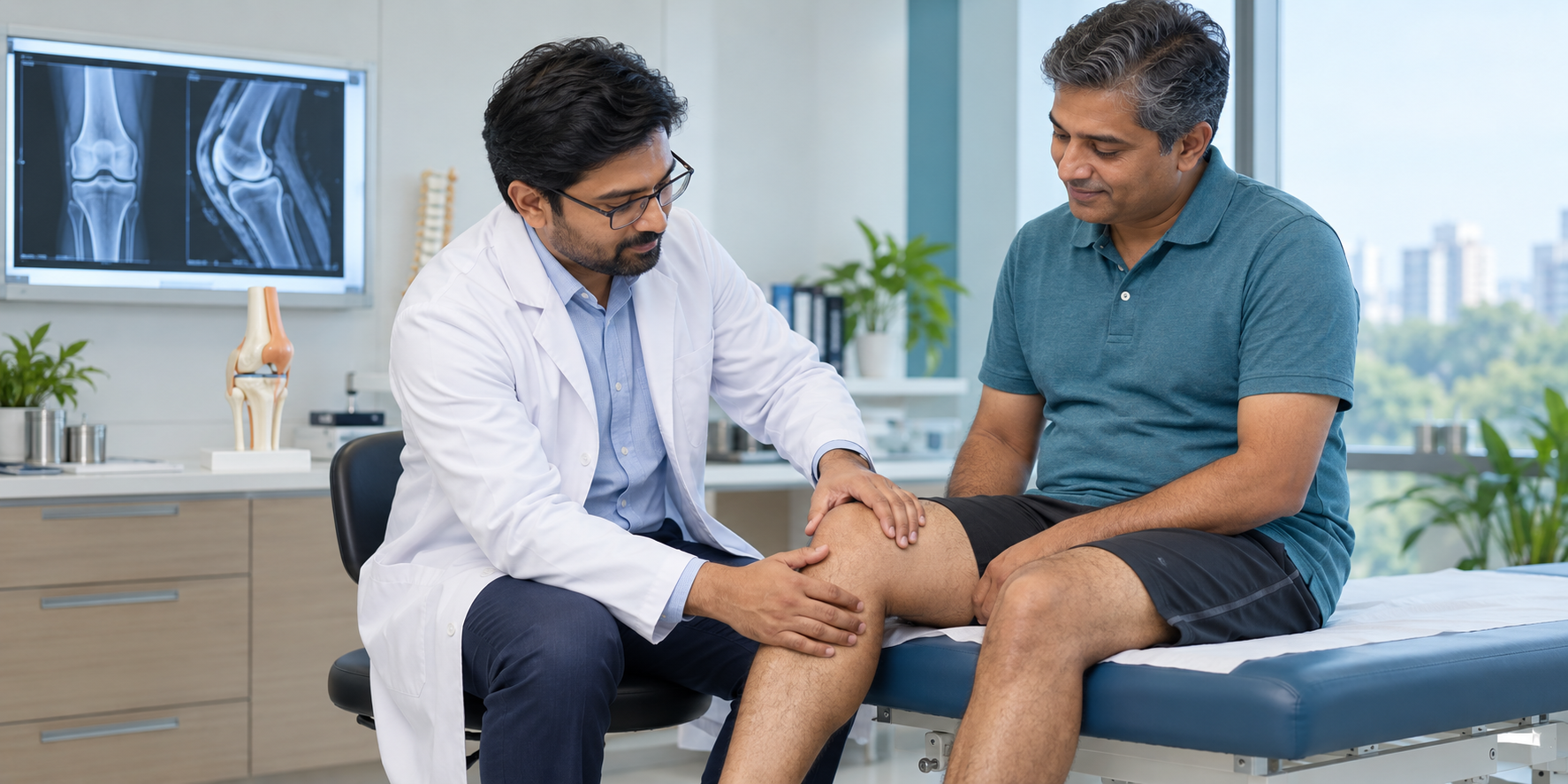
Comprehensive Knee Care in Bangalore
Knee pain can make everyday activities—walking, climbing stairs, exercising, working or even sleeping—more difficult. It may develop gradually due to arthritis and wear or appear suddenly after a sports injury, fall or accident.
Dr Samarth Arya provides comprehensive knee care in Bangalore for adults experiencing knee pain, stiffness, swelling, instability or restricted movement. Treatment is planned after identifying the underlying cause and may include physiotherapy, medication, lifestyle modification, joint-preservation treatment, knee arthroscopy or knee replacement surgery.
The objective is not simply to manage pain. It is to help patients regain movement, confidence and function through treatment suited to their condition, activity requirements and overall health.
When Should You Consult a Knee Specialist?
Occasional mild discomfort may improve with rest. However, an assessment by a knee specialist may be appropriate when symptoms persist, return frequently or begin to affect daily life.
Consider seeking medical advice if you experience:
- Knee pain lasting for several days or recurring regularly
- Swelling, stiffness or warmth around the knee
- Difficulty walking, climbing stairs or getting up from a chair
- Locking, catching or clicking associated with pain
- A feeling that the knee is giving way
- Pain following a sports injury, fall or accident
- Reduced ability to bend or straighten the knee
- Bowing, deformity or a noticeable change in leg alignment
- Knee pain that disturbs sleep
- Persistent pain despite rest, medication or physiotherapy
Severe pain following an injury, inability to bear weight, a visibly deformed knee, or a hot and swollen joint accompanied by fever requires prompt medical assessment.
Knee Conditions We Treat
Knee Osteoarthritis
Knee osteoarthritis develops when the smooth cartilage protecting the joint gradually becomes damaged. It may cause pain, stiffness, swelling, reduced movement and difficulty with walking or stairs.
Treatment depends on the degree of arthritis and its effect on the patient’s quality of life. Early and moderate arthritis can often be managed with exercise, physiotherapy, weight management, medication and selected injections. Advanced arthritis may require partial or total knee replacement when appropriate non-surgical treatment no longer provides adequate relief.
Meniscus Tears
The meniscus is a shock-absorbing cartilage structure inside the knee. Tears may occur during twisting injuries or develop gradually as the tissue changes with age.
Symptoms can include pain along the joint line, swelling, catching or difficulty fully bending and straightening the knee. Some meniscus tears can be treated without surgery, while unstable or repairable tears may require knee arthroscopy.
ACL and Other Ligament Injuries
The anterior cruciate ligament, or ACL, helps control knee stability. ACL injuries commonly occur during sports involving sudden turns, landing or rapid changes in direction.
Depending on the injury, age, activity expectations and knee stability, treatment may involve structured rehabilitation or ligament reconstruction. Injuries affecting the PCL, MCL and LCL are also evaluated and treated according to their severity.
Patellofemoral Pain and Kneecap Problems
Pain around or behind the kneecap may be associated with muscle weakness, altered tracking, overuse, cartilage irritation or kneecap instability.
Treatment generally begins with activity modification and focused physiotherapy. Recurrent kneecap dislocation or significant structural problems may require further intervention.
Cartilage Injuries
Joint cartilage may become damaged following an injury or because of progressive wear. Small, localised cartilage defects in selected patients may be suitable for cartilage-restoration or joint-preservation procedures.
The appropriate treatment depends on the size and location of the defect, leg alignment, ligament stability and the overall condition of the knee.
Sports and Overuse Injuries
Running, jumping, cycling and field sports can place repeated stress on the knee. Common problems include tendon irritation, ligament sprains, meniscus injuries and pain around the kneecap.
A diagnosis-based treatment plan helps patients recover safely and gradually return to their preferred sport or activity.
Knee Fractures and Post-Traumatic Arthritis
Fractures involving the kneecap or the bones surrounding the knee require careful assessment to restore joint alignment and stability. Previous fractures can also lead to post-traumatic arthritis years after the original injury.
Treatment may include immobilisation, rehabilitation, fracture fixation or reconstructive surgery depending on the injury.
How Knee Pain Is Diagnosed
A detailed evaluation is important because different knee conditions can produce similar symptoms.
The consultation may include:
- Discussion of symptoms, previous injuries and medical history
- Assessment of walking pattern and leg alignment
- Examination of knee movement, strength and stability
- Standing X-rays to assess the joint and its alignment
- MRI for selected ligament, meniscus or cartilage problems
- CT scanning when detailed assessment of bone or surgical planning is required
- Blood tests or joint-fluid analysis when infection or inflammatory disease is suspected
Not every patient with knee pain requires an MRI. The need for imaging is determined by the symptoms, examination findings and suspected diagnosis.
Non-Surgical Knee Pain Treatment
Many knee conditions can initially be treated without surgery. The plan may include:
- Temporary modification of painful activities
- Physiotherapy and guided strengthening exercises
- Improvement of flexibility and movement patterns
- Weight management where clinically appropriate
- Pain-relieving or anti-inflammatory medication
- Knee braces or walking aids for selected patients
- A gradual return-to-activity programme
- Joint injections in carefully selected situations
Injection treatment is not equally suitable for every knee condition. Its potential benefits, limitations and available alternatives should be discussed before proceeding.
Knee Preservation and Arthroscopy
When possible, treatment focuses on preserving the natural knee joint. Knee-preservation procedures may be considered for younger or active patients with localised damage, ligament instability or alignment problems.
Possible treatments include:
- Arthroscopic assessment and treatment
- Meniscus repair
- Removal of an unstable meniscus fragment when repair is unsuitable
- ACL or other ligament reconstruction
- Selected cartilage-restoration procedures
- Kneecap-stabilisation procedures
- Osteotomy to correct alignment and redistribute pressure across the knee
Knee arthroscopy is not routinely recommended for every patient with arthritis. It is used when symptoms and examination findings indicate a problem that is likely to benefit from the procedure.
Knee Replacement Surgery
Knee replacement may be considered when advanced joint damage causes persistent pain, stiffness and loss of function despite appropriate non-surgical care.
Partial Knee Replacement
Partial knee replacement replaces only the damaged compartment of the knee while retaining healthy bone, cartilage and ligaments. It is suitable only when arthritis is limited to a specific part of the joint and the remaining knee structures meet the necessary clinical criteria.
Total Knee Replacement
Total knee replacement may be recommended when arthritis or joint damage affects multiple areas of the knee. Damaged joint surfaces are removed and replaced with prosthetic components to create a stable and well-aligned joint.
Robotic-Assisted Knee Replacement
Robotic technology can assist with personalised surgical planning, bone preparation, alignment assessment and implant positioning. The surgeon remains in control throughout the operation and uses the system as a precision-guidance tool.
The choice between conventional, partial and robotic-assisted knee replacement is based on the patient’s knee anatomy, pattern of arthritis, medical health and individual requirements.
Your Knee Care Journey
1. Consultation and Assessment
The process begins with understanding the pain, its impact on daily activities and any previous treatment. The knee is then examined for movement, stability and alignment.
2. Diagnosis
Relevant investigations are reviewed or recommended to identify the condition and determine its severity.
3. Personalised Treatment Plan
Available options are explained in clear language. When non-surgical treatment is appropriate, this is usually considered before surgery.
4. Procedure and Rehabilitation
If surgery is required, patients receive guidance about preparation, hospital care and rehabilitation. Physiotherapy and progressive activity play an important role in recovery.
5. Follow-Up
Regular reviews help monitor healing, restore movement and address concerns during recovery.

Why Choose Dr Samarth Arya for Knee Care?
- Evaluation of both recent injuries and long-term knee conditions
- Treatment plans based on diagnosis, lifestyle and functional needs
- Emphasis on preserving the natural knee where clinically appropriate
- Expertise in arthroscopy, joint replacement and robotic-assisted surgery
- Clear discussion of surgical and non-surgical options
- Coordinated rehabilitation and follow-up care
- Consultation at Manipal Hospital, Old Airport Road, Bangalore
Consult a Knee Specialist in Bangalore
If knee pain, stiffness or instability is affecting your mobility, a detailed orthopaedic assessment can help identify the cause and suitable treatment options.
Book a consultation with Dr Samarth Arya at Manipal Hospital, Old Airport Road, Bangalore, for comprehensive knee pain treatment, joint-preservation care, arthroscopy and knee replacement evaluation.
Frequently Asked Questions
An orthopaedic knee specialist can assess pain caused by arthritis, ligament injuries, meniscus tears, cartilage problems, fractures or kneecap conditions.
Many patients with early or moderate arthritis can manage symptoms through exercise, physiotherapy, weight management, medication and activity changes. Surgery is considered when symptoms remain severe despite appropriate treatment.
Not always. X-rays are commonly used when arthritis or bone-related problems are suspected. MRI may be recommended for selected ligament, meniscus, cartilage or other soft-tissue conditions.
No. Treatment depends on the tear pattern, symptoms, age, activity level and whether the knee locks or remains painful. Some tears improve with rehabilitation, while others may benefit from repair or arthroscopic treatment.
Not every ACL injury requires surgery. Rehabilitation may be appropriate for some patients. Reconstruction is more commonly considered when the knee remains unstable or the patient wants to return to pivoting sports or demanding physical activities.
Knee replacement may be considered when advanced arthritis causes significant pain and disability and appropriate non-surgical treatments no longer provide adequate relief.
Partial knee replacement treats one damaged compartment, while total knee replacement addresses damage affecting multiple areas of the joint. Clinical examination and imaging help determine suitability.
No. The orthopaedic surgeon performs and controls the operation. The robotic system assists with planning, measurements, bone preparation and implant positioning.
Recovery varies according to the procedure, age, general health, condition of the knee and participation in rehabilitation. A personalised recovery plan is provided after assessment.
Arthroscopy is not routinely beneficial for general wear-and-tear arthritis. It may be considered when there is a specific mechanical problem, such as selected meniscus or cartilage injuries.
Treatment recommendations and recovery vary between patients. Information on this page is educational and should not replace an individual medical consultation.
Our Services
Get In Touch With Us
service timing ( Mon to Sat )
10 Am To 9 Pm