
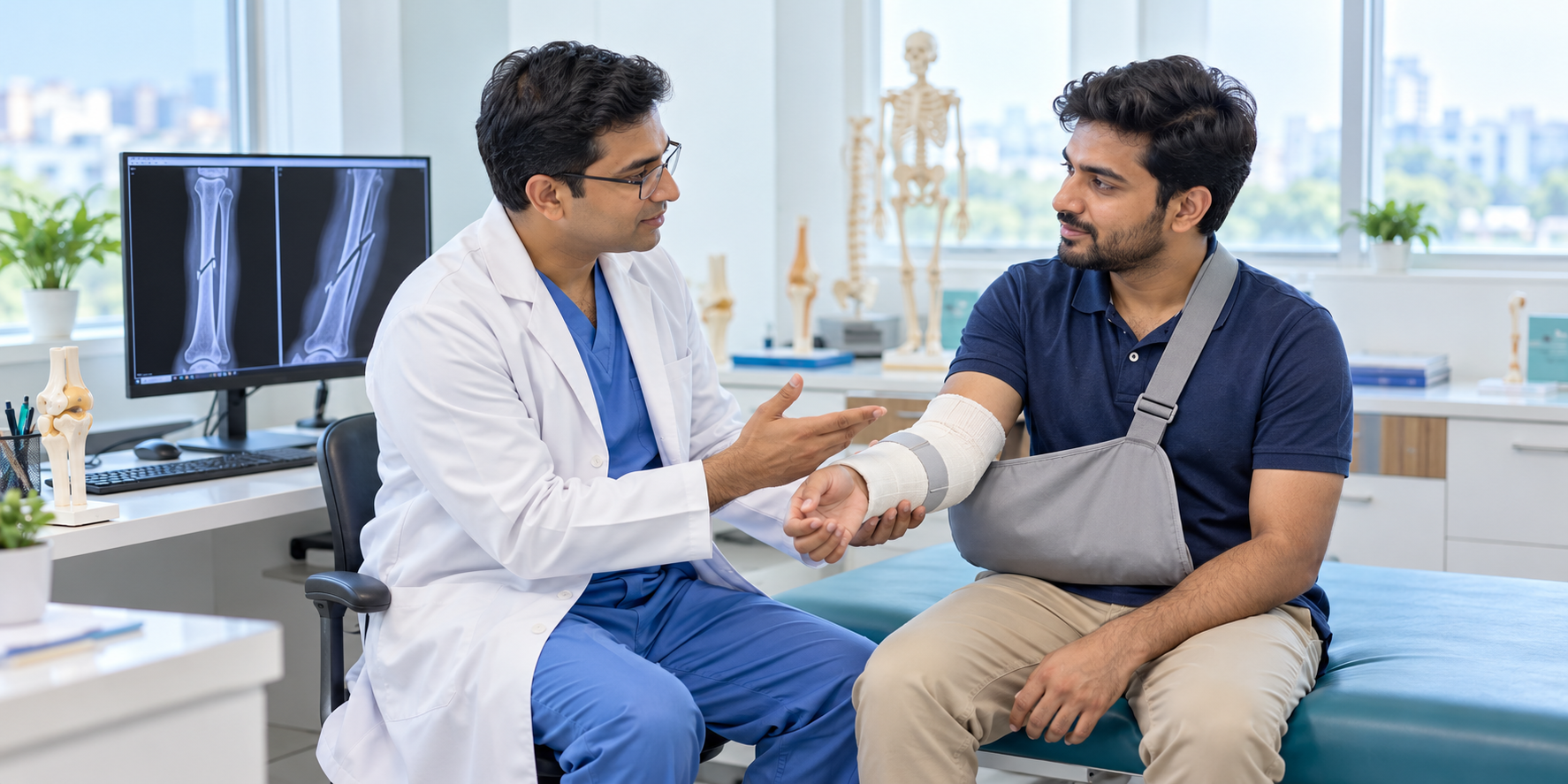
Comprehensive Trauma and Fracture Care in Bangalore
Fractures and orthopaedic trauma can occur following falls, road traffic accidents, workplace incidents, sports injuries or direct impact. Some fractures are straightforward, while others involve joints, multiple bone fragments, soft-tissue damage or previous unsuccessful treatment.
Dr Samarth Arya provides fracture evaluation and orthopaedic trauma care in Bangalore for adults with simple and complex bone and joint injuries. Treatment may include immobilisation, fracture reduction, internal fixation, external fixation, reconstruction and rehabilitation.
The objective is to restore bone alignment, protect surrounding tissues, support healing and help patients regain safe movement and function.
This page provides general information about orthopaedic fracture care. Serious accidents, uncontrolled bleeding, head or spinal injuries, breathing difficulty or loss of consciousness require immediate emergency medical attention.
When Does a Fracture Require Urgent Medical Attention?
Seek prompt medical assessment for severe pain after a fall or accident, swelling, bruising, visible deformity, inability to use the limb, numbness, an open wound near a suspected fracture or increasing pain after immobilisation.
Call emergency services or attend an emergency department immediately if bone is visible through the skin, bleeding is uncontrolled, the limb becomes cold or pale, the person has difficulty breathing or loses consciousness, or there is suspected head, spine or pelvic injury. Do not attempt to straighten a visibly deformed limb yourself.
Fractures and Trauma Conditions We Treat
Upper-Limb Fractures
Upper-limb fractures can involve the shoulder, upper arm, elbow, forearm, wrist or hand. Some can be managed with a sling, splint or cast, while unstable fractures may require fixation.
Lower-Limb Fractures
Lower-limb fractures may involve the hip, femur, knee, tibia, fibula, ankle or foot. Restoring alignment and stability is important for walking and joint function.
Fractures Around Joints
Fractures extending into a joint require careful assessment because an uneven joint surface can affect movement and increase the risk of post-traumatic arthritis.
Hip Fractures
Hip fractures commonly occur after falls among older adults. Treatment may involve fracture fixation, partial hip replacement or total hip replacement depending on the fracture, previous mobility and general health.
Open Fractures
An open fracture occurs when a wound communicates with the broken bone. It requires urgent medical treatment because of the risk of contamination, infection and soft-tissue damage.
Complex and Comminuted Fractures
A comminuted fracture contains multiple bone fragments. Complex fractures may also involve joints, muscles, skin, nerves or blood vessels.
Fragility Fractures
Fragility fractures can occur after a minor fall or low-energy injury when bones have been weakened by osteoporosis or another medical condition.
Stress Fractures
Stress fractures develop because of repeated loading rather than one major accident. They may affect runners, dancers, military personnel and people who rapidly increase physical activity.
Dislocations and Fracture-Dislocations
A dislocation occurs when joint surfaces move out of their normal position. Some injuries include both dislocation and fracture and require prompt assessment.
Non-Union and Delayed Union
A delayed union is a fracture taking longer than expected to heal. A non-union occurs when the bone does not unite without further treatment.
Malunion
A malunion occurs when a fracture heals in an unsatisfactory position. It may cause deformity, altered alignment, reduced movement or pain.
Implant-Related and Periprosthetic Fractures
A fracture may occur around a previous plate, nail, screw or joint-replacement implant. Treatment depends on implant stability, fracture pattern and bone quality.
How Fractures Are Diagnosed
Diagnosis begins with understanding how the injury occurred and assessing the injured limb as well as the patient’s general condition.
The evaluation may include:
- Examination for swelling, wounds and deformity
- Assessment of tenderness and movement
- Evaluation of blood flow, sensation and muscle function
- X-rays from appropriate views
- CT scanning for complex fractures or joint involvement
- MRI for selected stress fractures or soft-tissue injuries
- Blood tests before surgery or when infection is suspected
- Bone-density assessment for selected fragility fractures
- Additional trauma imaging after high-impact accidents
Not every fracture requires CT or MRI. Investigations are selected according to the injury pattern, clinical findings and treatment requirements.
Non-Surgical Fracture Treatment
Many stable and well-aligned fractures can heal without surgery. Non-surgical treatment may include:
- Sling, splint, brace or cast
- Closed reduction to restore alignment
- Temporary restriction of movement
- Partial or non-weight bearing
- Pain-management medication
- Regular X-rays to monitor alignment and healing
- Gradual movement when considered safe
- Physiotherapy after sufficient healing
Follow-up is important because some fractures can shift position after swelling reduces or activity increases.
Patients should seek medical advice if a cast or splint becomes excessively tight, damaged or wet, or if they develop increasing pain, numbness, swelling, colour changes or difficulty moving their fingers or toes.
Fracture Fixation and Trauma Surgery
Surgery may be recommended when a fracture is displaced, unstable, open, extends into a joint or cannot be maintained in a satisfactory position with a cast or brace.
Possible procedures include:
- Closed reduction and fixation
- Open reduction and internal fixation
- Plates and screws
- Intramedullary nails
- Wires or pins
- External fixation
- Fracture fixation around a joint
- Bone grafting for selected injuries
- Treatment of associated ligament or tendon injuries
- Revision fixation after unsuccessful previous treatment
- Partial or total joint replacement for selected fractures
- Corrective surgery for malunion
- Treatment of delayed union or non-union
The choice of fixation is based on fracture pattern, location, bone quality, soft-tissue condition, age, health and functional requirements.

Fracture Healing and Rehabilitation
Fracture recovery continues after the bone has been stabilised. Rehabilitation helps restore movement, strength, balance and confidence.
Healing varies according to the bone, fracture pattern, soft-tissue injury, age, health, bone quality, blood supply, smoking, infection, stability and adherence to rehabilitation instructions.
Pain reduction does not always mean that the bone has completely healed. Activity should be increased only according to clinical and imaging findings.
Your Trauma and Fracture Care Journey
1. Emergency Stabilisation When Required
Serious injuries are first assessed and stabilised by emergency and trauma teams. Life-threatening conditions take priority over individual fractures.
2. Orthopaedic Assessment
The injured limb, skin, circulation, sensation and movement are examined. The circumstances of the accident and medical history are reviewed.
3. Imaging and Diagnosis
X-rays and other investigations help define the fracture pattern and associated injuries.
4. Treatment Planning
The advantages, limitations and risks of non-surgical treatment and surgery are explained according to the injury.
5. Reduction or Surgery
The fracture is realigned and stabilised using the treatment most appropriate for the injury.
6. Early Recovery
Pain management, wound or cast care, safe movement and prevention of complications are addressed.
7. Rehabilitation
Movement, strength and weight bearing are progressed according to fracture healing.
8. Follow-Up
Clinical examination and follow-up imaging help monitor healing, alignment, implants and functional recovery.
Why Choose Dr Samarth Arya for Fracture Care?
- Evaluation of simple and complex fractures
- Experience in orthopaedic trauma and fracture fixation
- Management of fractures involving joints
- Treatment of delayed union, non-union and malunion
- Evaluation of fractures around existing implants
- Individualised surgical and non-surgical treatment planning
- Attention to bone alignment, joint function and mobility
- Coordination with emergency, medical and rehabilitation teams
- Structured postoperative and fracture-healing follow-up
- Consultation at Manipal Hospital, Old Airport Road, Bengaluru
Trauma and Fracture Care at Manipal Hospital, Old Airport Road
Patients undergoing orthopaedic trauma and fracture treatment at Manipal Hospital, Old Airport Road, Bengaluru, have access to emergency assessment, diagnostic imaging, operating facilities, medical support and rehabilitation services.
Complex trauma may require coordinated care involving orthopaedics, emergency medicine, anaesthesia, critical care, neurosurgery, vascular surgery and other specialties depending on the injuries.
Care location: Manipal Hospital, Old Airport Road, Bengaluru
For a severe accident or medical emergency, contact emergency services or proceed directly to the hospital’s emergency department rather than waiting for an outpatient appointment.
Frequently Asked Questions
Both can cause pain, swelling and difficulty moving. An examination and X-ray may be required to confirm whether a bone is fractured.
Sometimes. The ability to move or bear limited weight does not rule out a fracture.
No. Stable and well-aligned fractures can often be treated using a cast, splint, brace or sling.
Fracture reduction is the process of restoring broken bone fragments to a more appropriate alignment.
Internal fixation uses implants such as plates, screws, nails, wires or pins to stabilise a fracture while it heals.
Healing time varies according to the bone, fracture pattern, age, health, bone quality, blood supply and stability.
The timing depends on the fracture, treatment and evidence of healing. Some fractures allow early protected weight bearing while others require restriction.
Some swelling is expected. Rapidly increasing swelling, severe pain, numbness, colour changes or a tight cast requires urgent assessment.
An open fracture is a broken bone associated with a wound communicating with the fracture. It requires urgent hospital treatment.
Healing may be delayed by instability, infection, poor blood supply, smoking, bone loss, severe injury or certain medical conditions.
Not always. Removal is considered only in selected situations such as infection, implant irritation or another clinical reason.
Movement of unaffected joints and selected exercises may begin earlier, but rehabilitation must follow the surgeon’s instructions.
You can submit the enquiry form on this page for outpatient fracture evaluation or follow-up. Severe or recent trauma should be taken directly to the emergency department.
Individual treatment and recovery vary according to the injury and patient. This information is educational and does not replace emergency assessment or consultation with a qualified medical professional.
Our Services
Get In Touch With Us
service timing ( Mon to Sat )
10 Am To 9 Pm